The victors: Eisenhower and his boys: the men of World War II by Stephen E. Ambrose
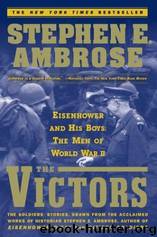
Author:Stephen E. Ambrose
Language: eng
Format: mobi
Tags: World history: Second World War
ISBN: 9780684856292
Publisher: New York, NY : Simon & Schuster, c1998.
Published: 2010-10-11T23:00:00+00:00
Generated by ABC Amber LIT Converter, http://www.processtext.com/abclit.html
hedge and then shoot.” The Germans also pre-sited mortars and artillery on the single gaps that provided
the only entrances into the fields. Behind the hedgerows, they dug rifle pits and tunneled openings for
machinegun positions in each corner. Wray moved up sunken lanes, crossed an orchard, pushed his way
through hedgerows, crawled through a ditch. Along the way he noted concentrations of Germans in fields
and lanes. A man without his woodsman’s sense of direction would have gotten lost. He reached a point
near the N-13, the main highway coming into Ste.-Mère-Eglise from Cherbourg.
The N-13 was the axis of the German attacks. Wray, “moving like the deer stalker he was”
(Vandervoort’s words), got to a place where he could hear guttural voices on the other side of a
hedgerow. They sounded like officers talking about map coordinates. Wray rose up, burst through the
obstacle, swung his M-1 to a ready position, and barked in his strong command voice,”Hände hoch!” to
the eight German officers gathered around a radio.
Seven instinctively raised their hands. The eighth tried to pull a pistol from his holster; Wray shot him
instantly between the eyes. Two Germans in a slit trench one hundred meters to Wray’s rear fired bursts
from their Schmeisser machine pistols at him. Bullets cut through his jacket; one cut off half of his right
ear.
Wray dropped to his knee and began shooting the other seven officers, one at a time as they attempted
to run away. When he had used up his clip, Wray jumped into a ditch, put another clip into his M-1, and
dropped the German soldiers with the Schmeissers with one shot each.
Wray made his way back to the company area to report on what he had seen. At the command post he
came in with blood down his jacket, a big chunk of his ear gone, holes in his clothing. “Who’s got more
grenades?” he demanded. He wanted more grenades.
Then he started leading. He put a 60mm mortar crew on the German flank and directed fire into the
lanes and hedgerows most densely packed with the enemy. Next he sent D Company into an attack
down one of the lanes. The Germans broke and ran. By mid-morning Ste.-Mère-Eglise was secure, and
the potential for a German breakthrough to the beaches was much diminished. The next day
Vandervoort, Wray, and Sgt. John Rabig went to the spot to examine the German officers Wray had
shot. Unforgettably, their bodies were sprinkled with pink and white apple blossom petals from an
adjacent orchard. It turned out that they were the commanding officer and his staff of the 1st Battalion,
158th Grenadier Infantry Regiment. The maps showed that it was leading the way for the counterattack.
The German confusion and subsequent retreat were in part due to having been rendered leaderless by
Wray.
Vandervoort later recalled that when he saw the blood on Wray’s jacket and the missing half-ear, he
had remarked, “They’ve been getting kind of close to you, haven’t they Waverly?”
With just a trace of a grin, Wray had replied, “Not as close as I’ve been getting to them, sir.”
At
Download
This site does not store any files on its server. We only index and link to content provided by other sites. Please contact the content providers to delete copyright contents if any and email us, we'll remove relevant links or contents immediately.
| Afghan & Iraq Wars | American Civil War |
| American Revolution | Vietnam War |
| World War I | World War II |
Waking Up in Heaven: A True Story of Brokenness, Heaven, and Life Again by McVea Crystal & Tresniowski Alex(37811)
Empire of the Sikhs by Patwant Singh(23086)
We're Going to Need More Wine by Gabrielle Union(19046)
Hans Sturm: A Soldier's Odyssey on the Eastern Front by Gordon Williamson(18592)
Leonardo da Vinci by Walter Isaacson(13336)
The Radium Girls by Kate Moore(12028)
Tools of Titans by Timothy Ferriss(8396)
Educated by Tara Westover(8054)
How to Be a Bawse: A Guide to Conquering Life by Lilly Singh(7486)
Permanent Record by Edward Snowden(5847)
The Last Black Unicorn by Tiffany Haddish(5636)
The Rise and Fall of Senator Joe McCarthy by James Cross Giblin(5280)
Promise Me, Dad by Joe Biden(5153)
The Wind in My Hair by Masih Alinejad(5095)
A Higher Loyalty: Truth, Lies, and Leadership by James Comey(4964)
The Crown by Robert Lacey(4817)
The Iron Duke by The Iron Duke(4356)
Joan of Arc by Mary Gordon(4112)
Stalin by Stephen Kotkin(3966)
